
Serbia from the 1990s to Today: War, Memory, and Dissent
Serbian memory of the 1990s includes wars, bombing, bereavement, migration, and deep political divisions. A serious account must hold together different civilian experiences and distinguish the actions of governments, armed forces, and individual citizens. This essay places Kosovo and the 1999 NATO air campaign within the wider dissolution of Yugoslavia; it does not claim to reconstruct every front or experience. It brings together three themes often kept apart in public memory: the wars of 1991–1995, civil dissent in Serbia, and the Kosovo crisis. The aim is to follow sources, distinguish individual and institutional responsibility, and avoid reducing any population to one experience.
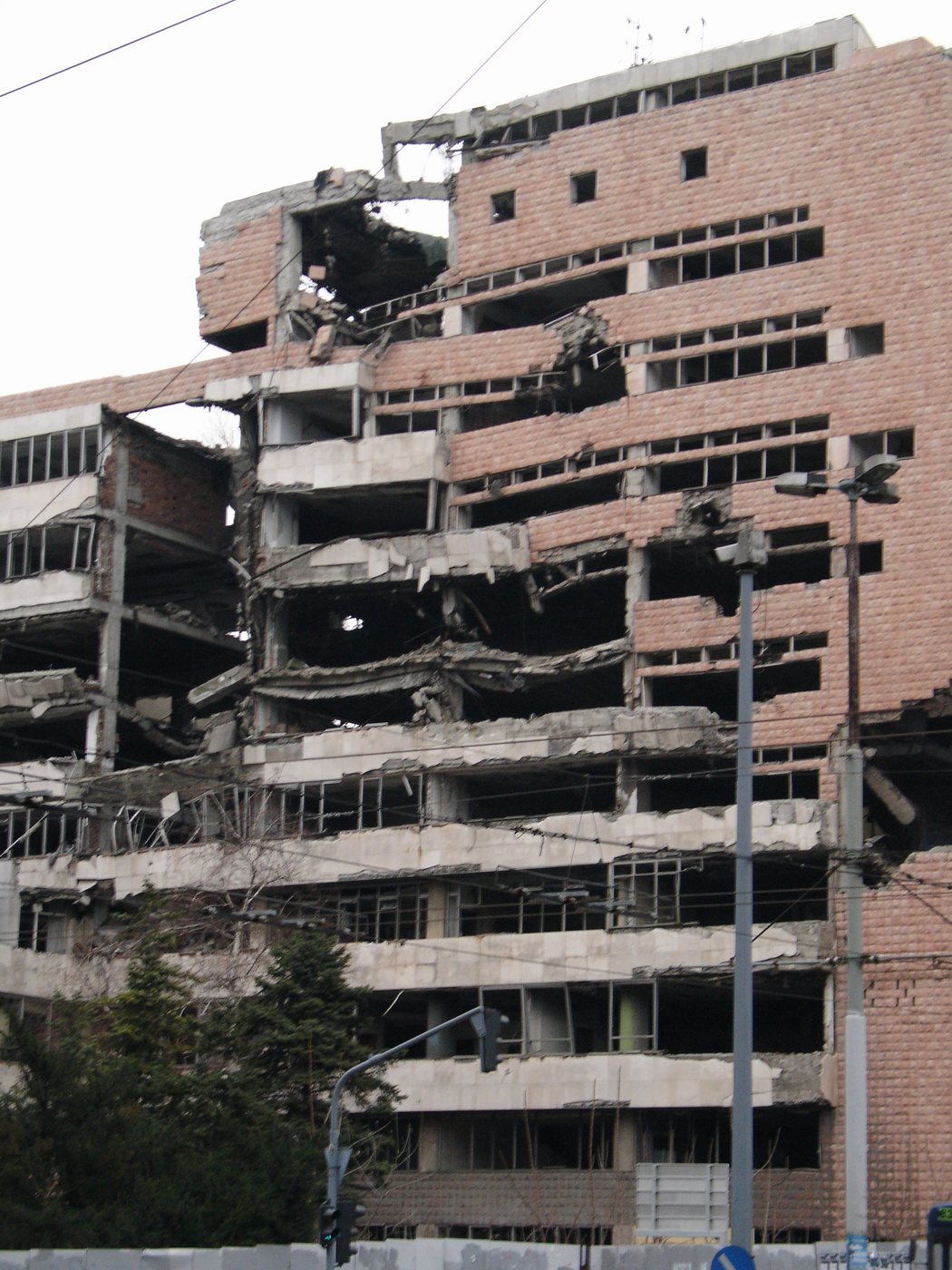
The breakup of Yugoslavia and the wars of 1991–1995
Serbia in the 1990s cannot be understood by isolating Kosovo from the other conflicts that followed Yugoslavia’s dissolution. The wars in Croatia and Bosnia and Herzegovina had their own actors, dynamics, and chronologies. International tribunals convicted individuals for crimes in different contexts; these judgments concern people and conduct proved in court, not the collective guilt of Serbs or any other community.
The International Criminal Tribunal for the former Yugoslavia offers an overview of the conflicts, while final judgments establish facts in individual cases. In July 1995, forces of the Army of Republika Srpska killed thousands of Bosniak men and boys at Srebrenica. In its 2007 judgment in Bosnia and Herzegovina v. Serbia and Montenegro, the International Court of Justice characterised the Srebrenica massacre as genocide and found that Serbia had breached its obligation to prevent genocide and to cooperate fully with the Tribunal. The Court did not find that genocide was legally attributable to Serbia, or that the state had committed, conspired to commit, or been complicit in genocide under the Convention.
This distinction between crimes established, individual criminal responsibility, and a state’s international responsibility is essential. Judicial recognition of Srebrenica does not erase victims from other groups or make the Serbian population collectively responsible. Similarly, remembering Serbian victims must not be used to deny or minimise the genocide and other established crimes. Public memory becomes more reliable when it preserves the specificity of each experience and assigns responsibility only where sources and courts support it.
Civil dissent in Serbia, 1996–2000
The history of the 1990s also includes internal mobilisation in Serbia. After the November 1996 municipal elections, the annulment of opposition victories led to extensive and largely peaceful protests involving citizens and students. An OSCE delegation verified opposition victories in fourteen cities; a UN Special Rapporteur’s report documents the demonstrations and restrictions on independent media.
In 2000, a further mobilisation followed the disputed results of the federal elections and culminated in the demonstrations in Belgrade on 5 October and the transfer of power. The National Assembly of Serbia’s institutional chronology records the confirmation of Vojislav Koštunica’s victory and subsequent parliamentary acts. These events remind us that Serbian society was not merely a spectator to government decisions: opposition groups, students, journalists, and citizens challenged authoritarian rule and demanded respect for the vote.
Kosovo before the air campaign
The Kosovo crisis had roots predating the bombing. During the 1990s, tensions worsened between Serbian and Yugoslav authorities and Kosovo’s Albanian majority. Repression, human-rights violations, armed insurgency, and violence against civilians all occurred. Human Rights Watch documents abuses and violations of humanitarian law by different actors, while its Under Orders report focuses on the campaign of killings, forced expulsions, and persecution carried out by Serbian and Yugoslav forces against Kosovo Albanians in 1999.
The NATO air campaign began on 24 March 1999 and ended in June, after an agreement led to the withdrawal of Serbian and Yugoslav forces and the entry of KFOR. During those months, many families in Serbia experienced air-raid alerts, shelters, disruption to daily life, and damage to infrastructure. In Kosovo, hundreds of thousands of Albanians were expelled or forced to flee, while civilians from several communities suffered violence. The sequence and scale of events should be reconstructed through distinct sources, not collapsed into one narrative.
Bombing and civilian casualties
Estimates of civilian deaths during the air campaign vary according to methods and incidents counted. Human Rights Watch estimated between 488 and 527 civilian deaths; Amnesty International published an estimate of about 500 killed and 900 injured. These are estimates attributed to those organisations, not a definitive count agreed by all archives.
Human-rights organisations criticised attacks in which, in their view, obligations to protect civilians were not adequately respected. Amnesty International concluded that some attacks caused unlawful killings; Human Rights Watch documented civilian casualties and assessed specific incidents. The ICTY committee report reviewed allegations concerning the campaign and recommended that no criminal investigation be opened. That decision concerned whether to open an investigation into possible war crimes; it was not an overall court judgment on the legality of the military intervention.
These assessments should be read for what they are: Amnesty and Human Rights Watch are documentation and advocacy organisations; the ICTY committee was a preliminary assessment body for the Prosecutor, not a court that held a trial on the air campaign. Precise attribution allows these attacks to be discussed without assigning a source a verdict it did not issue.
Victims and responsibility in the conflict
Civilian suffering during the bombing does not erase persecution and crimes committed against Kosovo Albanians by Serbian and Yugoslav forces. Human Rights Watch’s 2001 report documents killings, torture, rape, and forced deportations during the 1999 campaign. It also examines abuses by the Kosovo Liberation Army, including abductions and killings, and violations by NATO. Human Rights Watch also documented violence against Serbs, Roma, and other minorities after Serbian and Yugoslav forces withdrew.
Bringing these events into one contribution does not declare them equivalent in scale, purpose, or responsibility. It means refusing selective memory: one community’s suffering must not become the price of silence about another’s. Responsibility is individual and institutional; it does not pass automatically to an entire population, language, or later generation.
Serbian memory and internal plurality
For many Serbian families, 1999 remains a trauma associated with air strikes, civilian deaths, the loss of Kosovo, and a sense of international isolation. Recognising this memory does not require approval of every decision made by the governments of the Federal Republic of Yugoslavia, nor does it require denial of crimes committed in the conflict.
Serbian society is not a uniform block. Internal dissent, protests, and demands for civic accountability are part of the country’s contemporary history. The European Commission’s Serbia Report 2026 describes student and civic protests, calls for accountability, and tensions over fundamental freedoms. This is an institutional assessment of the period covered by the report, not a measure of every citizen’s views.
Political autonomy and personal conscience
Contemporary Serbia pursues EU accession while maintaining a policy of military neutrality. On foreign policy, the European Commission’s 2026 report notes only partial alignment with the EU’s Common Foreign and Security Policy and Serbia’s non-alignment with restrictive measures against Russia. These are state policies and assessments; they do not automatically describe the beliefs of the Serbian population.
In this project, autonomy is a subject for examination, not a moral medal. A country’s ability to choose its course must be distinguished from citizens’ freedom to challenge institutions, demand transparency, or advocate another direction. Political sovereignty and freedom of conscience can support one another, but they are not synonyms.
Contemporary Serbia: protest and political competition
Recent student and civic protests have brought public accountability, anti-corruption demands, and the protection of freedoms back to the centre of debate. In its Serbia Report 2026, the European Commission records continuing protests, incidents of violence against demonstrators and journalists, and persistent difficulties in ensuring freedom of expression and assembly. This is the Commission’s assessment for the period under review, not a description of every citizen’s views.
The early parliamentary elections of 25 October 2026 had high participation but took place in a highly polarised climate and under campaign conditions international observers judged uneven. Their statement of 26 October was preliminary: it reported structural advantages for the governing party, reported pressure and intimidation, and concerns over the transparency of the count. It does not replace the final report.
The contemporary picture is not a simple opposition between “Serbia” and “external pressure.” It includes internal political differences, demands for change, competing international orientations, and debates about the EU, Kosovo, and Russia. State sovereignty, government policy, and citizens’ freedoms are connected but distinct. The memory of the 1990s should not be used to close present debate or discredit dissent.
Comparison with medieval dissent
Placing contemporary Serbia alongside the Bogomils does not claim that a medieval movement transmitted a political tradition to modern society. The periods, actors, and contexts differ. The comparison is philosophical: what does it mean to defend dignity when a person or community is under pressure? How can resistance to injustice avoid becoming a justification for inflicting injustice on others?
Resistance deserves attention when it protects life, memory, and the possibility of dissent. To assess it, we must also ask what means it uses, who bears the cost, and whether it leaves room for the dignity of those considered enemies. This is a moral question addressed to all actors, not a collective judgment about a people.
Sources and limits of reconstruction
- International Criminal Tribunal for the former Yugoslavia, “The Conflicts” and “Judgement List,” for the overview and case-specific findings on the wars of 1991–1999.
- International Court of Justice, Application of the Convention on the Prevention and Punishment of the Crime of Genocide (Bosnia and Herzegovina v. Serbia and Montenegro), judgment, 26 February 2007.
- UN Commission on Human Rights, Special Rapporteur, Situation of human rights in the territory of the former Yugoslavia, E/CN.4/1997/56 (1997), sections on the 1996 Serbian local elections and protests.
- National Assembly of the Republic of Serbia, “After Second World War,” official parliamentary chronology surrounding October 2000.
- Human Rights Watch, Civilian Deaths in the NATO Air Campaign (2000).
- Amnesty International, Federal Republic of Yugoslavia (FRY)/NATO: “Collateral damage” or unlawful killings? (5 June 2000).
- ICTY, Prosecutor’s report on the NATO bombing campaign and review committee report (2000). The decision not to open an investigation is not an overall judgment on the legality of the intervention.
- Human Rights Watch, Under Orders: War Crimes in Kosovo (2001).
- Human Rights Watch, Abuses against Serbs and Roma in the New Kosovo (1999).
- European Commission, Serbia Report 2026, on the political situation, protests, and civic freedoms covered by the report.
- International Election Observation Mission (ODIHR, OSCE PA, PACE, and European Parliament), preliminary statement on Serbia’s parliamentary elections of 25 October 2026 (26 October 2026).
This contribution distinguishes organisational estimates, preliminary prosecutorial assessments, and documentation reports. Sources and conclusions are described within their respective scope, without turning them into collective judgment of Serbian or Albanian populations.