
Medieval Serbia: Nemanja, Orthodoxy, and Dissent
Medieval Serbia was not merely a backdrop to Bogomil history. In the second half of the twelfth century, Grand Župan Stefan Nemanja consolidated his power and promoted a political order linked to Orthodoxy. Serbian sources say that people described as heretics were condemned and persecuted during his rule. Their identification as Bogomils is plausible and common in scholarship, but the texts do not describe their doctrine precisely enough to remove all doubt.
This essay treats the episode as a question of religious and political history. It does not assume continuity between medieval dissent and modern Serbian identity; it examines how orthodoxy, sovereign authority, and the limits of religious difference were defined in medieval society.
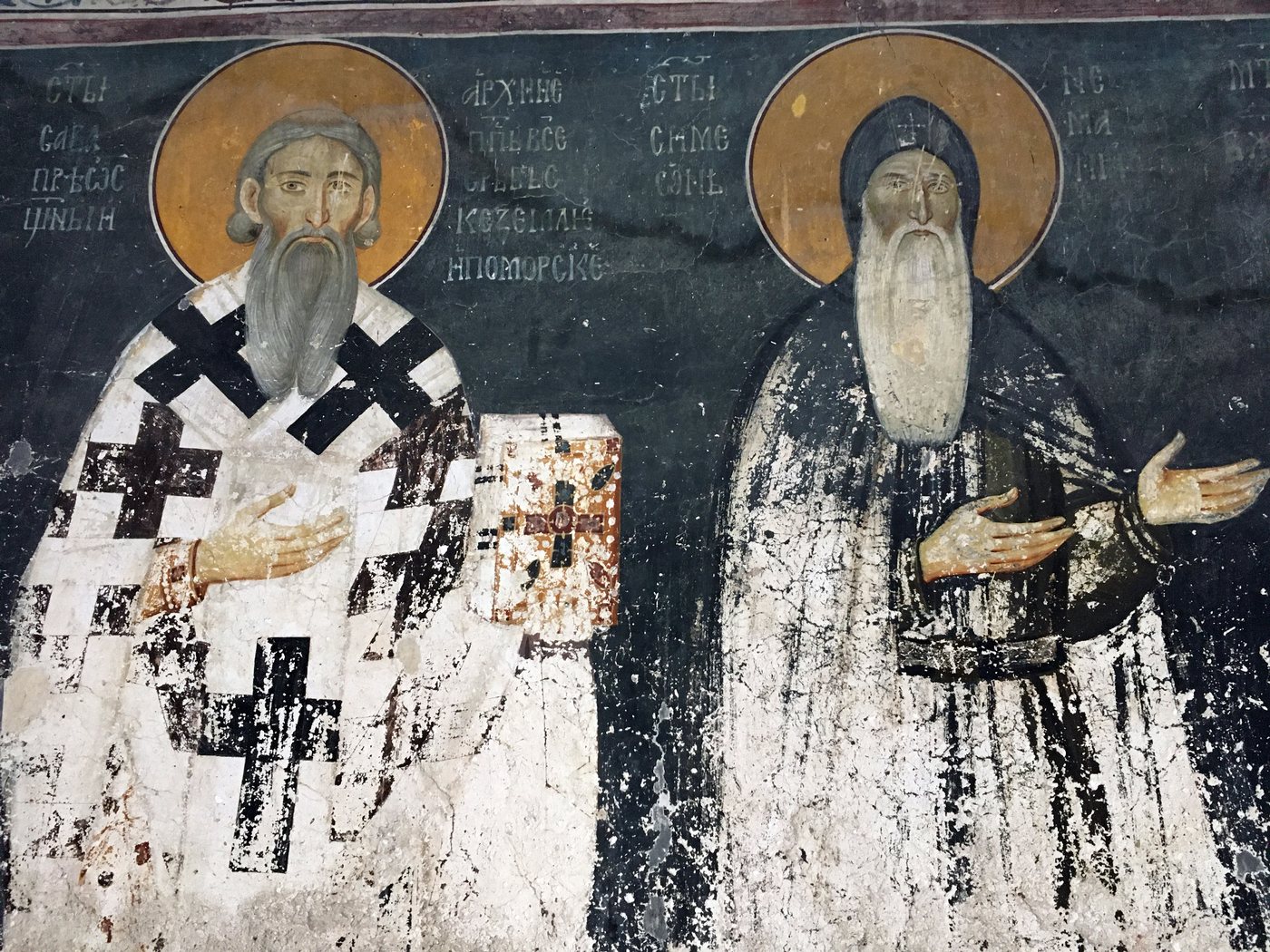
The main source: a dynastic and religious life
The best-known account of repression appears in the Life of Simeon, written by Stefan Prvovenčani, Nemanja’s son, in the early thirteenth century. It recalls that Nemanja convened an assembly against heresy, condemned its supporters, and ordered their books destroyed; it presents the ruler as a defender of the faith.
This is not an administrative chronicle or a trial record. It is a dynastic and hagiographic text composed to preserve an exemplary memory of the founder of the Nemanjić dynasty. That genre does not make the testimony useless, but it requires us to ask what image of the ruler the author sought to construct, which details he selected, and what was left out. The source says much about how the Serbian court and Church wished Nemanja to be remembered; it says less about the precise beliefs and motives of the accused.
Scholars have often identified the heretics as Bogomils, considering the spread of dualism in the Balkans and parallels with Bulgarian and Byzantine polemics. John V. A. Fine and Andrew P. Roach discuss the problem within the broader history of Balkan religion. Caution remains necessary: Stefan’s text does not explicitly name a Bogomil community or systematically set out its doctrine. It is therefore more accurate to write “a group regarded as heretical, often identified as Bogomil” than to present the identification as certain.
Nemanja and the formation of political order
Nemanja ruled at a time when Balkan powers continually negotiated their position among Byzantium, the papacy, Hungary, and local forces. The formation of a more stable political authority proceeded alongside the definition of dynastic, monastic, and ecclesiastical ties. Religion was not separate from politics: it legitimised power, shaped community, and connected the ruler to a wider Christian order.
Nemanja and his sons played a central role in monastic patronage and the dynasty’s religious memory. After renouncing power, Nemanja took the monastic name Simeon; texts by his sons Sava and Stefan transformed his life into a model of a Christian ruler and founder. In this context, defending Orthodoxy was not an isolated episode: it helped shape the ideal ruler, alongside founding monasteries and caring for the dynasty.
The condemnation of heresy should therefore be read on several levels. It was a religious action against what authorities considered deviant; it also affirmed the ruler’s ability to convene, judge, and protect the Christian order. This does not reduce faith to a cover for power. It recognises that medieval religious convictions, institutions, and government supported and influenced one another.
Sava’s religious policy: discipline and persuasion
The story does not end with the repression attributed to Nemanja. In 1219, under his son Sava, the Serbian Church gained the status of an autocephalous archbishopric: its own ecclesiastical organisation, not ordinarily subordinate to appointment by another see. The date and circumstances are reconstructed from ecclesiastical sources and later narratives; the event was nevertheless a major institutional transition in Serbian history.
Andrew P. Roach’s study of Sava’s preaching and strategies in the thirteenth-century Balkans emphasises that action against heresy did not rely on coercion alone. Sources also show efforts to persuade heretics to return to the Orthodox Church and to make religious instruction more effective. Roach describes this setting as a competition for religious affiliation. This modern phrase should not suggest that medieval people had the same concept of choice as people today, but it helps reveal the range of strategies.
This comparison should not turn Nemanja into a symbol of tolerance or Sava into an advocate of modern religious freedom. It helps distinguish different moments and instruments: public condemnation, ecclesiastical discipline, preaching, and attempts to bring dissenters back to Orthodoxy. The history of religious institutions is more complex than a simple opposition between persecution and freedom.
Autocephaly and freedom of conscience are different concepts
Ecclesiastical autocephaly is institutional autonomy for a Church. It is not equivalent to individual religious freedom or to separation of Church and state. In Serbia, the archbishopric’s autonomy strengthened the kingdom’s religious organisation and its capacity to train clergy. This is important to Serbian history, but it does not demonstrate that people outside Orthodoxy were free to organise or practise their faith.
The distinction is central to this project. A people or institution may seek autonomy from an external authority while imposing religious or political unity internally. Medieval practices were linked to ideas of community and power different from modern individual rights. Our task is to understand that context without confusing categories and without giving up moral questions about the past.
What we know and what remains uncertain
- Attested: the Life of Simeon attributes a campaign against heresy to Nemanja and mentions punitive measures and the destruction of books.
- A scholarly identification: many scholars associate the accused with the Bogomils, but the Serbian account does not describe their doctrine sufficiently to remove all uncertainty.
- Context: the Nemanjić court linked dynastic power, monastic patronage, and the promotion of Orthodoxy.
- Contemporary interpretation: reading this episode through the question of freedom of conscience can be fruitful, but it does not mean medieval actors formulated modern rights.
A question for Balkan history
The Serbian case prevents an idealised picture of religious resistance: a political power consolidating its autonomy could also suppress spiritual dissent. This contradiction is not a flaw to hide; it is a historical fact to understand. It reminds us that a state’s independence and its inhabitants’ freedom of conscience are related but distinct questions.
This is how the medieval case enters the site’s project. We do not seek a Bogomil origin for modern Serbia. We place different histories in dialogue through a question: how can a community defend its dignity while also recognising the conscience of those who do not share the dominant orthodoxy?
Sources and bibliography
- Stefan Prvovenčani, Žitije svetog Simeona [Life of Saint Simeon], in Sabrani spisi, ed. Ljiljana Juhas-Georgievska (Belgrade: Prosveta; Srpska književna zadruga, 1988), pp. 9–50. Hagiographic and dynastic source.
- John V. A. Fine Jr., The Late Medieval Balkans: A Critical Survey from the Late Twelfth Century to the Ottoman Conquest (University of Michigan Press, 1994), especially the discussion of twelfth-century Serbian political history and sources on heretics.
- Andrew P. Roach, “The Competition for Souls: Heresy, Orthodoxy and Consumer Choice in Religion in the Thirteenth-Century Balkans,” Glasnik 50, no. 1 (2006), 141–159.
- Andrew P. Roach, “Changes in Identity and Ideology in the Byzantine World in the Second Half of the Twelfth Century: The Case of Serbia,” in Changes in the Byzantine World in the Twelfth and Thirteenth Centuries.
This essay distinguishes medieval testimony, scholarly reconstruction, and contemporary philosophical reflection. The identification of the accused as Bogomils remains a historiographical hypothesis, not a documentary certainty.